


Your morning coffee can do more than deliver caffeine. Keto coffee for mental clarity combines black coffee with fats such as butter or ghee and MCT oil, blended into a smooth, latte-like drink. A practical recipe uses 250 millilitres of coffee, one tablespoon of butter or ghee and one tablespoon of MCT oil. It’s calorie-dense, so think of it as a substantial drink rather than a plain, low-calorie coffee.
If you’re considering keto coffee for mental clarity, caffeine may be familiar, but adding fats makes it a different kind of drink. Learn how keto coffee is made, what caffeine and fats contribute, and how to fit it into a focused morning routine. We’ll also look at practical ways to adjust your recipe and timing.
Key Takeaways
- Blend coffee and fats until smooth to create a creamy, emulsified drink.
- Track caffeine from all sources and keep your daily intake in mind as you plan your routine.
- Adjust the added fats to suit your appetite, and notice how the drink fits into your energy and focus through the morning.
- Choose Bullet Proof Keto Coffee when you want a convenient option for your keto coffee routine.
What is Keto Coffee?
Keto coffee combines brewed coffee with added fats, such as butter or ghee and medium-chain triglyceride (MCT) oil. Blending disperses the fats through the coffee, creating a creamy, latte-like texture. The drink is calorie-dense, so treat it as a substantial part of your morning routine, not as plain black coffee.
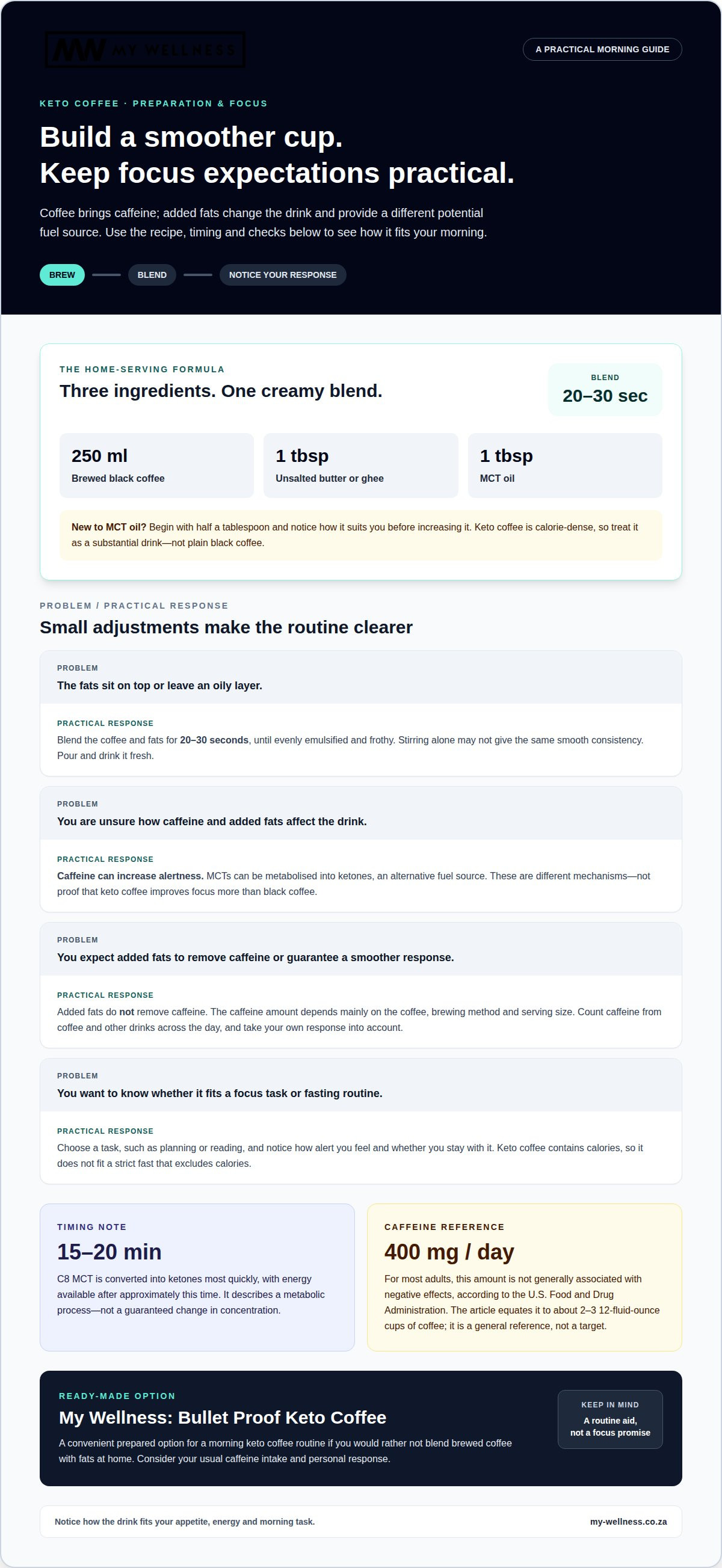
- Brew the coffee. Start with 250 millilitres of black coffee. Keto coffee doesn’t automatically contain less caffeine than regular coffee; the amount depends mainly on the coffee, brewing method and serving size. Added fats don’t remove caffeine.
- Add fats gradually. For a home serving, blend the coffee with one tablespoon of unsalted butter or ghee and one tablespoon of MCT oil. If you’re new to MCT oil, start with half a tablespoon and see how it suits you before increasing it.
- Blend until creamy. Use a blender for 20-30 seconds, until the fats are evenly emulsified and the surface looks frothy. Stirring alone may leave an oily layer, while blending gives the drink its smooth consistency. Pour it into a mug and drink it fresh.
- Choose ingredients carefully. In South Africa, look for coffee, butter or ghee, and MCT oil at grocery or health-food retailers. Read each label for the ingredient list, added sugars, flavourings and serving guidance. Ghee is clarified butter; MCT oil is a concentrated fat, so begin with a modest amount.
As the body metabolises MCTs, some can be converted into ketones, an alternative fuel source. That does not make every cup a guaranteed route to mental clarity. Caffeine content and the amount of added fat both shape the drink, so keep the recipe simple and notice how it fits your morning.
Caffeine and fats as sources of sustained energy
Separate caffeine’s alerting effect from the fuel supplied by dietary fats. Then consider how your coffee habits and personal response shape your experience.
-
Distinguish brain fuel from alertness
Compare keto coffee with black coffee by looking at what each contains: black coffee provides caffeine, while keto coffee also supplies fats. Caffeine can increase alertness; MCTs can be metabolised into ketones, an alternative fuel source for the brain. These are different mechanisms, not proof that one drink improves focus more than another. Other focus drinks may contain different ingredients, so read their labels rather than assuming they have similar effects.
-
Consider caffeine’s effects
Notice how caffeine affects your attention and reaction time after a cup. It blocks adenosine receptors, reducing a signal associated with tiredness, which can make you feel more alert. Fats may slow caffeine absorption, but they do not remove caffeine or guarantee a smoother response. Added fats also make keto coffee calorie-dense, unlike plain black coffee. If caffeine disrupts your sleep or makes you feel unsettled, take that response into account.
-
Account for tolerance and limits
Count caffeine from coffee and other drinks across the day, then consider your own tolerance. For most adults, 400 milligrams of caffeine a day, about two to three 12-fluid-ounce cups of coffee, is not generally associated with negative effects, according to the U.S. Food and Drug Administration. This is a general reference, not a target. If caffeine or added fats are a concern because of your health needs or medicines, discuss keto coffee with a healthcare professional first. Choose a lower-caffeine or fat-free drink if those ingredients don’t suit you.
For a ready-made option to fit into this routine, explore Bullet Proof Keto Coffee.
Keto coffee and mental focus
Keto coffee combines caffeinated coffee with added fats, including MCT oil. Caffeine may support alertness, while ketones provide another fuel source, but the combination does not guarantee clearer thinking.
- Set a focus goal. Before your morning cup, choose a task that needs sustained attention, such as planning work or reading. Notice whether caffeine helps you feel alert and whether that feeling supports your ability to stay with the task. This practical comparison can help you decide if the drink fits your routine, rather than relying on a broad promise of mental clarity.
- Consider the timing. MCT oil is metabolised into ketones, and C8 MCT is converted into ketones most quickly, with energy available after approximately 15-20 minutes. That timing describes a metabolic process, not a guaranteed change in concentration. Try keto coffee before a focused morning task, then observe how the caffeine and fats feel together.
- Decide whether fasting fits. Some people use keto coffee to extend intermittent fasting because it supplies fat calories without carbohydrates or sugar. However, it isn’t calorie-free, so it doesn’t fit a strict fast that excludes calories. For example, if you follow a 16:8 schedule, decide whether adding a calorie-containing drink suits your fasting approach before making it part of your morning.
- Keep expectations practical. Treat keto coffee as a drink that may complement a focus routine, not as a substitute for sleep, food or task planning. The useful takeaway is simple: caffeine drives alertness, while MCT-derived ketones provide a different potential fuel source. Track your own response alongside the task and timing.
Explore keto coffee options as you build a routine around focused mornings.
My Wellness: Bullet Proof Keto Coffee
My Wellness Bullet Proof Keto Coffee offers a convenient way to include keto coffee in your morning routine. Choose it if you’d rather use a prepared product than blend brewed coffee with fats at home. Its clean formula contains no artificial additives, proprietary blends or junk. As with any caffeinated drink, consider your usual caffeine intake and personal response.
Use it as one part of a broader routine, not as a promise of sharper focus. Your sleep, workload and overall eating pattern also shape how alert you feel. If you’re deciding whether it suits your approach, contact My Wellness to discuss Bullet Proof Keto Coffee.
Make your next morning intentional
Build your routine around the kind of focus your day calls for. Notice how coffee fits alongside sleep, meals and workload, then make practical, sustainable adjustments. Think of keto coffee for mental clarity as one option within a broader approach to wellbeing, not a shortcut or a substitute for supportive daily habits.
My Wellness also offers the GLP-1 Daily Support Shake, GLP-1 Hydration Support Strawberry Lemonade and GLP-1 Muscle Protect Creatine. Explore the range that best fits your wellness routine, or contact My Wellness to discuss its offerings. Take the next step at your own pace and keep building habits that support the way you want to feel.
Frequently Asked Questions
How much is safe?
For most adults, the U.S. Food and Drug Administration says 400 milligrams of caffeine a day is not generally associated with negative effects. Count caffeine from all drinks, not only keto coffee. Your own tolerance matters too: if caffeine affects your sleep or makes you feel uncomfortable, reduce your intake rather than treating that figure as a personal target.
What are ketones and how do they work in the brain?
Ketones are molecules the body can produce from fat, and they can serve as an alternative fuel source for the brain. MCT oil can be metabolised into ketones, but having ketones available does not automatically mean you’ll think more clearly. Caffeine’s alerting effect is separate, so distinguish feeling more awake from a measurable improvement in concentration.
What ingredients are commonly used in keto coffee for mental clarity?
Common ingredients include brewed coffee, butter or ghee, and MCT oil. Some recipes also add collagen peptides for protein. For example, choose unsalted butter or ghee, then blend the fats thoroughly into the coffee. Read ingredient labels for added sugars, flavourings and serving guidance, especially when using a prepared product or managing dietary requirements.
What does research say about ketogenic diets, ketones, and cognitive function?
Ketogenic diets have been used to treat epilepsy in children for over 100 years, but that history doesn’t prove they improve focus for everyone. Keep the distinction clear: evidence for a diet’s use in a particular clinical context is not proof that keto coffee boosts everyday cognitive performance.