


Butter or oil in keto coffee breaks a true fast, so timing matters more than the “keto” label. That does not automatically mean bulletproof coffee will hinder weight loss: its effect depends on how it fits into your overall eating pattern. If you want to keep your fast intact, save it for when you are ready to eat.
The appeal is clear: creamy coffee can feel more satisfying than a plain cup, especially as you approach your eating window. But added fats mean you are no longer fasting, even when the drink is low in carbohydrates.
This guide to keto coffee for intermittent fasting explains how to make a simple version, choose a sensible serving size and time it around your fast and ketone production.
You will also learn when to drink it if you want to extend your complete fast, and how to account for it in a weight-loss routine.
Key Takeaways
- Use a measured blend of brewed coffee, butter or ghee, and MCT oil, then adjust the richness to suit your routine.
- Count the added fats as part of your intake; keto coffee is not a meal replacement.
- Learn how fasting duration and what you add to your coffee can influence the conditions for ketone production.
- Explore My Wellness Bullet Proof Keto Coffee as a convenient option, or consider the GLP-1 Daily Support Shake for a different kind of wellness support.
Bulletproof coffee recipe and serving sizes
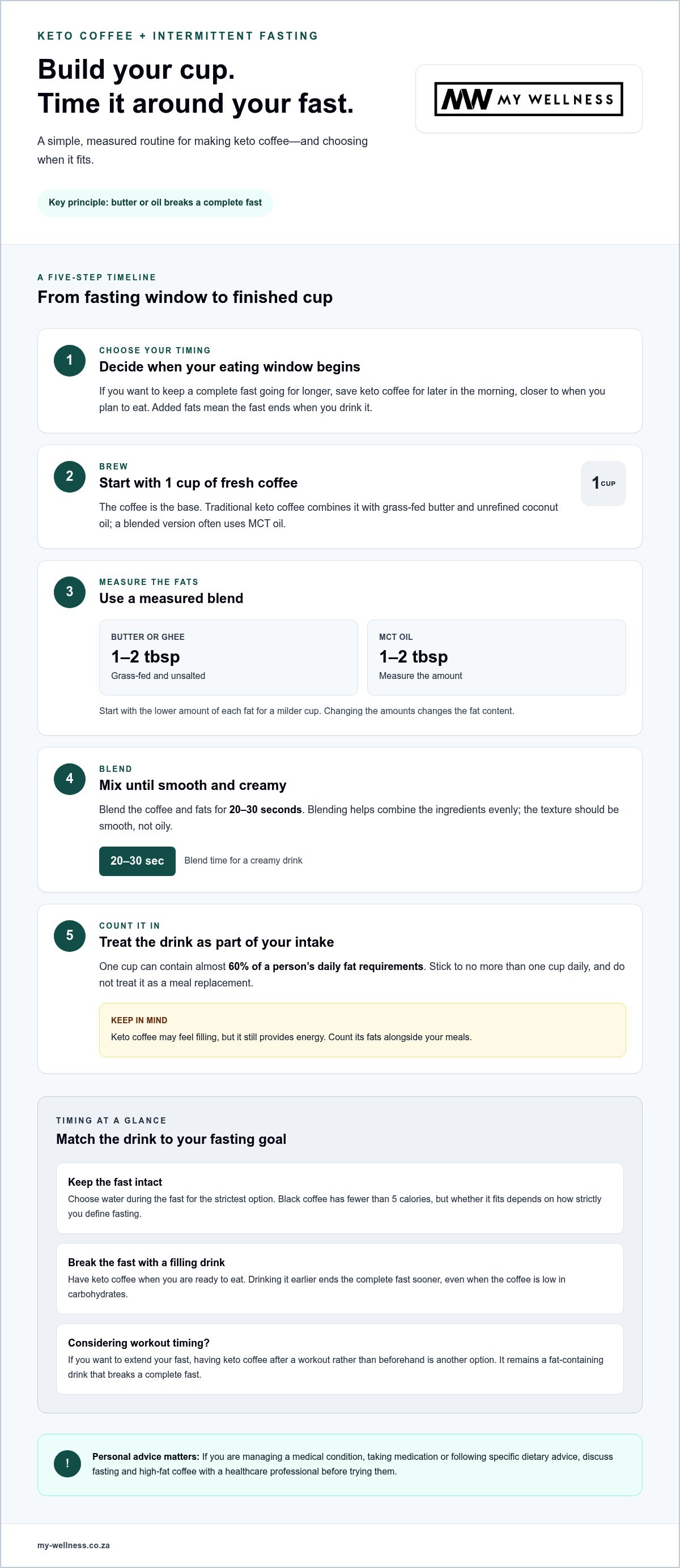
Traditional keto coffee combines grass-fed butter with unrefined coconut oil. A blended version often uses MCT oil instead, creating a smooth drink with added fats. Measure the serving, as these ingredients contribute substantially to your daily fat intake.
- Coffee: Brew 1 cup of fresh coffee.
- Butter or ghee: Add 1 to 2 tablespoons of grass-fed, unsalted butter or grass-fed ghee.
- MCT oil: Add 1 to 2 tablespoons.
Blend the coffee and fats for 20 to 30 seconds, or until creamy. Start with the lower amount of each fat for a milder cup. The texture should be smooth, not oily; blending helps combine the ingredients evenly.
One cup can contain almost 60 per cent of a person’s daily fat requirements. That makes serving size worth considering alongside your meals, rather than treating the drink as a negligible coffee addition. Measure each ingredient, since changing the amounts changes the fat content.
When adapting a recipe for keto coffee for intermittent fasting, first decide when your eating window begins. A smaller portion can make the drink less substantial, but it still adds fat to your routine.
Plan keto coffee for intermittent fasting deliberately. Stick to no more than one cup daily, and do not use multiple cups or replace meals with it. Its fats may increase satiety, but the drink still provides energy. Treat it as one part of your eating routine, not a complete meal.
Intermittent fasting and ketone production
Intermittent fasting commonly involves fasting for 16 or more hours per day. During the fast, the body moves through the energy available from recent food. As that supply changes, the liver can produce ketones from fat. The timing and amount vary with factors such as your previous meal, carbohydrate intake and activity.
Ketosis is defined here as blood ketone levels of 0.5 mM or greater. That figure describes a measurable ketone level, not a promise that every 16-hour fast will reach it. Fasting duration is one influence, while what you ate beforehand and your wider eating pattern also matter.
Think of fasting and ketosis as related, but not identical, processes. A person can follow a fasting schedule without knowing their blood ketone level. Likewise, a ketone reading reflects the moment it is measured, rather than explaining every part of someone’s routine. The 0.5 mM threshold helps clarify what ketosis means in this context.
For a practical example, a 16-hour fasting window followed by an eating window creates a clear structure. The fasting period alone doesn’t show whether ketone production has reached 0.5 mM. A meal rich in carbohydrates before the fast, for instance, changes the context compared with a lower-carbohydrate meal.
Be clear about your goal: fasting can support a shift towards ketone production, but the clock is not a ketone meter. If tracking ketosis matters to your plan, a blood ketone measurement gives a direct reading. Consider it alongside your meal pattern and fasting duration, rather than relying on elapsed hours alone.
When to drink keto coffee during intermittent fasting
Choose when to drink it based on whether you want to maintain a complete fast or end it with a filling drink. Added fats make the difference.
Keto coffee timing
Adding butter or coconut oil to coffee may be incompatible with a strict fast. To keep your complete fast going for longer, drink it later in the morning, closer to when you plan to eat. That way, your fasting window stays intact for longer.
After a workout is another option if you want to extend your fast rather than drink keto coffee beforehand. The potential benefit is a satisfying, fat-containing drink when you are ready to break your fast. The trade-off is straightforward: drinking it earlier ends the fast sooner, even if the coffee is low in carbohydrates.
If you are managing a medical condition, taking medication or following specific dietary advice, discuss fasting and high-fat coffee with a healthcare professional before trying them.
Black coffee during a fast
Black coffee contains no added butter, oil or other ingredients. A cup has fewer than 5 calories, but whether it fits your fast depends on how strictly you define fasting. If your approach allows a near-zero-calorie drink, plain black coffee may fit; it isn’t the same as a water-only fast.
If your priority is the highest level of migrating motor complex activation, choose water during the fast. This is a clear option for keeping the fasting period as strict as possible. Adding butter or oil makes the drink more substantial, so it may not suit a strict fast.
Black coffee offers a coffee break without the added fats of a keto version. Keto coffee may feel more filling, but its ingredients end a complete fast and add energy. Decide whether your priority is maintaining the fast or having a richer drink near your eating window.
My Wellness: GLP-1 Daily Support Shake
My Wellness GLP-1 Daily Support Shake is an option to explore if you want a dedicated product for your GLP-1 support routine. It’s separate from the timing choice covered above: a shake isn’t a substitute for deciding whether coffee with added fats fits your fasting window.
Choose based on the kind of support you’re looking for. The range also includes GLP-1 Hydration Support Strawberry Lemonade and GLP-1 Muscle Protect Creatine, while Bullet Proof Keto Coffee is the coffee option. These are distinct products, so consider which best aligns with your routine rather than treating them as interchangeable.
For a straightforward next step, contact My Wellness to explore the GLP-1 Daily Support Shake.
Make your next choice intentional
Build a routine around what matters most to you: keeping your fast intact, choosing when to break it, or enjoying a drink that fits your eating window. Your approach to keto coffee for intermittent fasting should support your wider routine, not become an automatic rule. Notice how the timing fits your day, then shape the habit to keep it practical and consistent.
If you’re exploring broader wellness support, My Wellness also offers GLP-1 Hydration Support Strawberry Lemonade and GLP-1 Muscle Protect Creatine, alongside the GLP-1 Daily Support Shake. Consider which option best fits what you’re looking for.
Contact My Wellness for support as you consider your next step. Keep your routine thoughtful, flexible and centred on your needs.
Frequently Asked Questions
Can bulletproof coffee slow down weight loss?
Yes, keto coffee can make weight loss harder if its added energy increases your intake without replacing other food. For example, drinking it alongside your usual breakfast adds to the meal rather than substituting for it. Count the coffee as part of your overall eating pattern, not as a calorie-free drink. Its “keto” label does not determine its effect on weight.
Does Bulletproof Coffee Break a Fast?
Yes. Whether a fat-added coffee fits your fast depends on how you define your fasting approach. If you keep a fasting log, record the time you drink it as the point your fast ends. This makes your fasting window easier to track consistently, rather than counting from when you finish the cup.
What are MCTs?
MCTs are medium-chain fatty acids, which contain 6 to 12 carbon atoms. Caprylic acid, also called C8, has eight carbon atoms and is one type of MCT. In keto coffee, MCT oil is used as a fat ingredient. The term describes the fatty-acid chain length, not a separate style of coffee.
What is Keto Coffee?
Keto coffee is brewed coffee combined with added fats, rather than coffee served black. It is commonly associated with low-carbohydrate eating, where the added fats suit the drink’s intended style. This distinction matters during fasting: a plain cup and a fat-added cup are not equivalent choices, even though both start with coffee.
What is keto coffee and what ingredients are commonly used?
A typical version starts with brewed coffee blended with grass-fed butter or ghee and MCT oil. Traditional recipes may use unrefined coconut oil instead. These ingredients make a richer drink than black coffee. The proportions affect how substantial the cup feels, so measure the fats rather than adding them by eye.