


Keto macros aren’t a one-size-fits-all ratio. If you’ve searched how to calculate macros for keto and found conflicting numbers, there’s a reason: calculators can use different calorie estimates and carbohydrate targets.
To work out your macros, you need to know how calories translate into grams and which personal details affect your estimate. This guide walks you through estimating daily calories, setting protein and carbohydrate targets, then calculating the fat that fills the remaining allowance. You’ll also learn how to review your numbers and make measured adjustments, rather than treating a calculator result as a guarantee.
Use this as a practical framework, not a rigid prescription. If you have a health condition or take medication, seek individual clinical guidance before making a major dietary change.
Key Takeaways
- Understand how protein, carbohydrates and fat contribute to your daily macros, and why keto targets vary from person to person.
- Learn how to calculate macros for keto in sequence, from estimating calories to working out the fat that fills the remaining allowance.
- Compare carbohydrate approaches and choose a starting target that suits your needs, rather than assuming one number works for everyone.
- Track consistently for a manageable period, then review hunger, energy and how sustainable the plan feels before making measured adjustments.
How keto macros work: understand calories, protein, carbs and fat
Macros, short for macronutrients, are protein, carbohydrate and fat. They provide energy and support different bodily functions: protein helps build and maintain body tissues, carbohydrates supply energy, and fat provides energy and helps the body absorb certain vitamins. Each gram provides a different amount of energy: protein and carbohydrate provide four calories per gram, while fat provides nine. This conversion explains how a calorie target becomes a set of macro targets.
Keto is a low-carbohydrate eating pattern with a greater share of calories coming from fat. The ketogenic diet can be structured in different ways, so there isn’t one carbohydrate target that suits everyone. Your goal, preferences and individual needs all matter. Learning how to calculate macros for keto is about understanding the method, not simply copying someone else’s ratio.
What makes a macro target specific to you?
Age, height, weight and activity level can all affect an estimate of your daily energy needs. Your goal matters too: the calorie estimate you use may differ depending on whether you’re aiming to maintain your weight or change it. A calculator uses the details you enter, along with its own formula and assumptions, to produce an estimate. It doesn’t directly measure your needs.
Treat the result as a starting point, not a prescription or a guaranteed outcome. Two calculators can give different figures if they use different assumptions or if you enter different activity levels. Use consistent personal details and regard the first result as a guide to review, rather than a fixed rule. Then set your targets in a clear order.
How to calculate macros for keto, step by step
Work through the numbers in order. This makes it easier to understand how each target is set, rather than relying on a calculator result you can’t interpret.
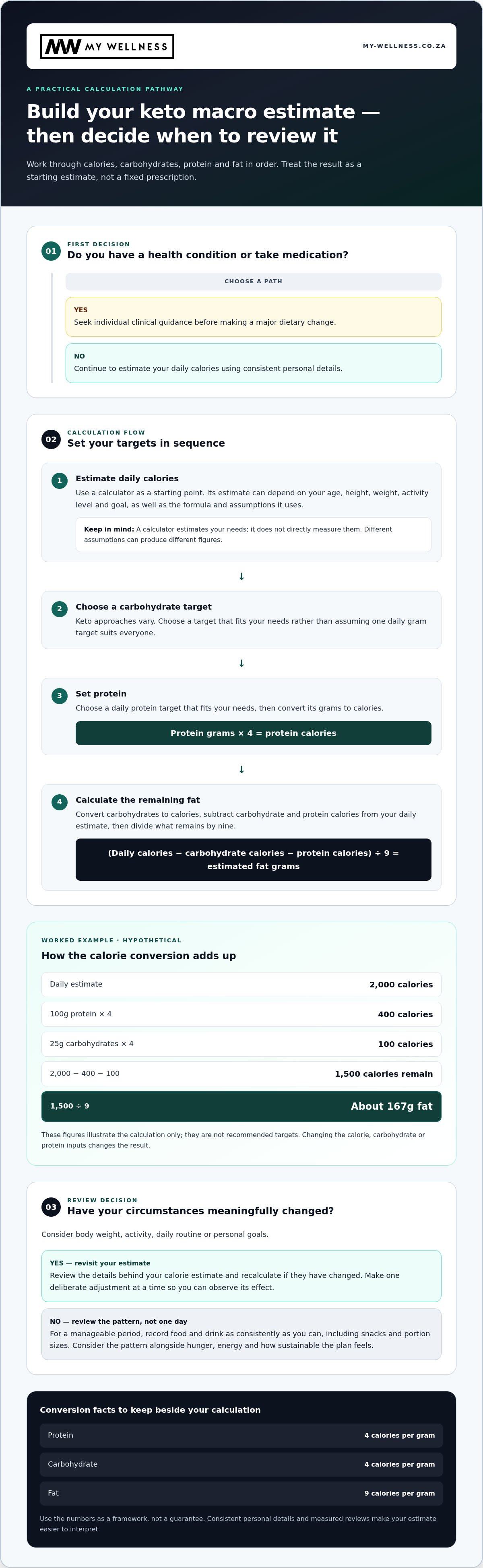
- Estimate daily calories. Use a calculator as a starting point, based on your personal details and goal.
- Choose a carbohydrate target. Keto approaches vary, so don’t assume one daily gram target is right for everyone. Choose an approach that fits your needs before calculating the other macros.
- Set protein. Choose a daily protein target that fits your needs. Multiply the grams by four to find the calories it contributes.
- Calculate the remaining fat. Subtract the calories from carbohydrates and protein from your daily calorie estimate. Divide what remains by nine to estimate fat grams.
For context, the Harvard T.H. Chan School of Public Health outlines typical ketogenic macronutrient proportions and considerations. Use any ratio as context, not as a substitute for choosing targets that suit your circumstances.
How do you turn your calorie target into macro grams?
Multiply protein grams and carbohydrate grams by four to find their calorie contributions. Subtract both figures from your daily calorie estimate, then divide the remainder by nine. This gives you the estimated grams of fat needed to complete the calculation.
Hypothetical example, for illustration only: With a daily estimate of 2,000 calories, 100g of protein contributes 400 calories, and 25g of carbohydrates contributes 100. Subtract 500 from 2,000 to leave 1,500 calories. Divide 1,500 by nine for about 167g of fat. These figures aren’t recommended targets. Changing the calorie, carbohydrate or protein inputs changes the result.
Once you’ve set your estimates, you can explore keto food options to help plan meals around them. Check how each food fits your calculated targets, including its carbohydrate and protein contribution.
How to use and adjust your keto macro targets realistically
Your macro figures are estimates, not a perfect readout of what your body needs. Use them as a framework and look for patterns over time instead of judging your progress by one day of eating. A meal out, a change in routine or an imperfect food log can shift your daily totals without showing whether your overall approach is working.
For a manageable period, record what you eat as consistently as you can. Include drinks, snacks and portion sizes, and review the pattern alongside hunger, energy and how manageable the plan feels. The aim isn’t to track perfectly. It’s to gather enough information to decide whether your targets and routine feel sustainable.
When should you revisit your keto macro calculation?
Reassess your numbers after a meaningful change in body weight, activity, daily routine or personal goals. For example, if your schedule changes and you become more or less active, your original calorie estimate may no longer be a useful guide. Revisit the details behind how to calculate macros for keto rather than reacting to normal day-to-day fluctuations.
Make one deliberate adjustment at a time, then give yourself a chance to observe the pattern. Changing several targets at once makes it harder to tell what helped. If you’re managing a health condition, speak with a qualified health professional before making a major dietary change.
Food choices can help you put a plan into practice, but they don’t set your targets for you. My Wellness options include Keto Muscle Meals and Bullet Proof Keto Coffee. Check the nutrition information for any product you choose and include it in your own daily totals.
Build a keto routine that feels workable
Choose one practical way to put your targets into everyday eating, then give that routine time before deciding what to change. The value of learning how to calculate macros for keto isn’t chasing perfect numbers. It’s having a clear framework for making thoughtful choices that fit your life. Keep your approach flexible and let consistency guide you, rather than feeling pressure to get every detail right from day one.
If keto-friendly options would make planning more straightforward, My Wellness offers Bullet Proof Keto Coffee and Keto Muscle Meals. They’re optional choices, not substitutes for selecting portions and foods that suit your macro plan. Explore the keto range from My Wellness and choose products that fit your approach.
Frequently Asked Questions
Do I need to hit my keto macros exactly every day?
No. A daily target is a guide, not a pass-or-fail test. Food portions and nutrition information can vary, so small differences are normal. Avoid trying to “make up” for a higher total by severely restricting food the next day. Instead, return to your usual routine and use your records to spot a consistent pattern.
Can I calculate keto macros without knowing my body-fat percentage?
Yes. You can estimate how to calculate macros for keto using details such as your age, height, weight, activity level and goal. Some calculators offer body-fat percentage as an optional input, but it isn’t essential for every method. If you don’t know it, leave that field blank rather than entering a guess that could skew the estimate.
How do I calculate net carbs from a food label?
If the label lists total carbohydrate and dietary fibre separately, a common tracking method is to subtract fibre from total carbohydrate. For example, a hypothetical serving with 12g total carbohydrate and 4g fibre would give 8g net carbs. Check what your tracking app means by “net carbs”, and don’t automatically subtract other ingredients unless its method accounts for them.
Can keto macro targets change over time?
Yes. Targets may need reviewing if your circumstances or chosen goal changes. For example, a new work schedule that alters your usual activity could make an old estimate less relevant. Recheck the assumptions behind your calculation, then update only what needs changing. If a health professional is guiding your diet, discuss target changes with them.